
This article was originally printed in the Mar/Apr 2026 issue of the California Veterinarian magazine.
Disclaimer: I logged into my laptop using a fingerprint to unlock it, which is artificial intelligence (AI)-enabled to improve identification accuracy. I then opened my AI-enabled web browsers and typed in “PacVet Conference Keynotes” to get an idea of whose footsteps I was following, and I read the “AI Overview” from the past several conferences. Next, I opened my bibliography software, Papers, enhanced with AI capabilities, to pull together key literature on AI in veterinary medicine using the “Recommendations” button. I then used ChatGPT 5.0, a large language model, to generate a catchy title when I gave the prompt: “I am writing an article for a veterinary magazine introducing the concept of AI in veterinary medicine. What are some catchy titles?” I picked one from the list and used it unedited (see above). ChatGPT 5.0 was then asked to create an outline of key talking points to guide the piece’s overall structure. Next, I opened Microsoft Word, which, you guessed it, has “AI integrated directly into it!” and I dictated my first draft using natural language processing. The writing you see below is my own, but grammatical suggestions were made with Grammarly, an AI tool that is like spell check on steroids. Once it was all written, I emailed it off, a process I’m guessing uses AI in the background. Long story short…I used AI to help me write this.
Artificial intelligence (AI) is more than a buzzword. It is touching our lives in innumerable ways; it’s nearly impossible to navigate your daily life without interacting with some type of AI-enabled tool. These tools can help us be more productive, navigate from point A to point B, communicate more effectively, and touch up photographs. With these tools now ubiquitous, it makes sense that they’re also being integrated into the health care space.
There has been an explosion of publications and direct-to-consumer tools in health care, along with nearly 1,000 U.S. Food and Drug Administration-approved AI-enabled medical devices, nearly 100 times what was available a decade ago.1 A similar pattern is being observed in veterinary medicine. Tools that leverage AI are being marketed to us with promises to enhance our quality of life, improve our efficiency, or improve patient outcomes. But how best do we utilize these tools? How do we deploy them safely? How do we know they work as intended? The days of avoiding AI tools are likely over, and we as a profession need to be able to answer these important questions.
Artificial intelligence is a broad field of research and development that encompasses robotics, deep learning, machine learning, and many other subareas. I encourage readers to consult the many review articles by our colleagues that delve into AI and its facets of development and deployment in the context of veterinary medicine.2-9 At its most fundamental level, AI uses complex statistical methods to learn patterns from datasets that may be too subtle or intricate for the human mind to recognize. You might think about this in the context of classifying animal species.
A data set with 100,000 photos of different animals may train an AI model to learn the complex patterns that are associated with birds, dogs, or cows; then, when presented with a new piece of data, if the model is robust and well-trained, it will be able to correctly classify the new image. This is not unlike the process we use when we learn to classify animals or shapes as children.10 With the growing capabilities in computing power and the vast amount of digital data being produced, these models are now more powerful than we can imagine, many with capabilities beyond the human mind.
The draw of AI tools into the practice of medicine seems like a natural fit. Health care fields generate a lot of data, and this data is often complex and multimodal. Our veterinary clients are often interested in collecting detailed, continuous data from their pets, such as from wearable glucose monitors, litter boxes that measure weight, or water bowls that quantify intake.
Veterinary professionals are increasingly being asked to synthesize this mass of continuous data with physical examination findings, blood work, genetic data, and imaging. Our clients are turning to us as trusted experts, asking us to digest this data, to distinguish the signal from the noise, and to provide proactive health care to their pet. Leveraging AI to meet these growing demands may provide a pathway to better care.
It seems that almost every week, new AI tools are introduced that could be applied to veterinary practice. These include dictation software that listens to your consults and generates medical records; models that aid in interpreting radiographs or blood smears; and platforms that analyze blood work to predict disease states or provide prognostic information. There are even more AI tools that are being marketed directly to consumers in the pet care space, including a bark-to-English translation app. Alarmingly, in one study, when veterinarians were asked whether they used AI tools in practice, 56% answered “no” without context; when given specific examples of such tools, they then reported using AI products.11 This suggests that many of us are likely using AI-based tools without recognizing it. So, with all these tools available, and in some cases where the integration of AI isn’t immediately clear to the user, how do we use them safely? How do we know if we can trust them?
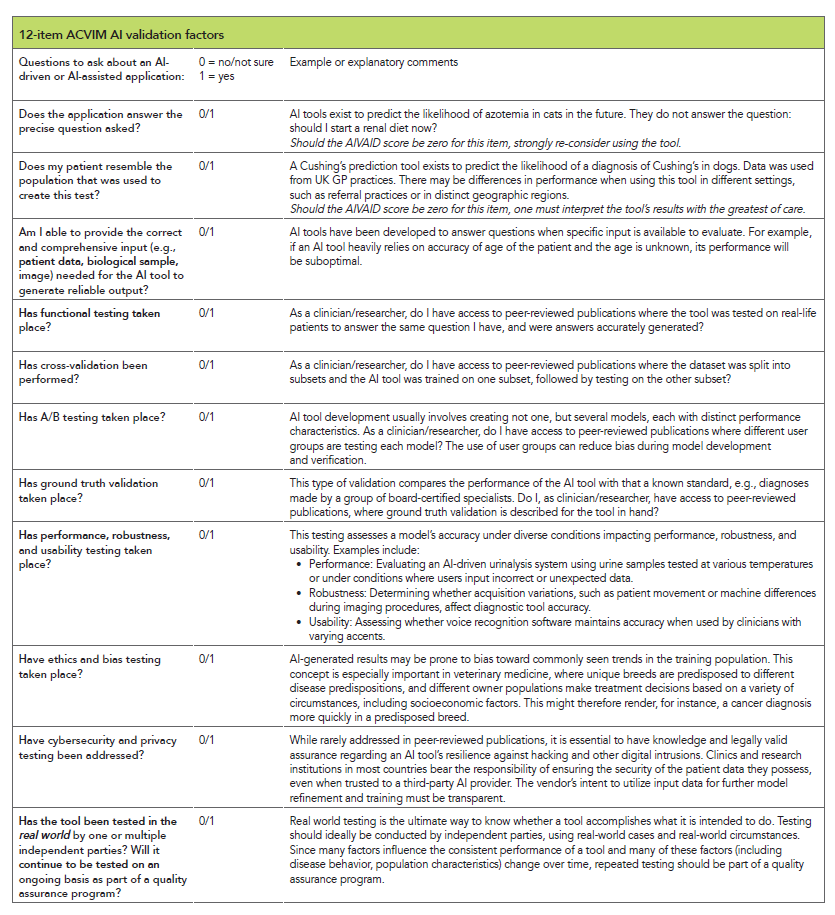
There are some fundamental questions we should ask regarding AI tools before applying them in a clinical setting. Some of these include understanding the precise question being asked of the AI tool, the functional testing that has taken place, the performance statistics, and the ground truth being compared to. Without a centralized oversight or governance system, it is up to the end users to ask these questions. One proposed rubric is presented by the American College of Veterinary Internal Medicine’s (ACVIM) 12-item checklist for AI validation factors (see table below).9
While there are no specific cut-offs in this system for when a tool is acceptable to use, tools with higher scores may generally be used with greater confidence in the clinical setting. Overall, veterinary professionals and students report low levels of AI literacy. While veterinary specialists surveyed had high levels of AI skepticism, students—the next generation of veterinarians—showed low skepticism.11,12 There should be an effort to improve AI literacy in our profession, starting at the veterinary curriculum level, so veterinarians are poised to use tools like the ACVIM AI validation system to rationally and safely apply AI tools.
We are at a turning point in veterinary medicine; whether we are ready or not, new AI technology will be integrated into our practices. There are potentially huge benefits for our patients, for animal health, and for our well-being if we learn how best to apply these tools and determine the situations in which they may be helpful…or harmful. As a profession, we should have a seat at the table to discuss hard questions about data privacy, oversight, and expectations for the validation and monitoring of these tools. We should be proactive in ensuring we have the knowledge to engage in meaningful conversations about the future of veterinary medicine. We should position ourselves to be the best stewards of this technology. To quote Dr. Jesse Ehrenfeld, the president of the American Medical Association, “AI is not going to replace doctors—but doctors who use AI will replace those who don’t.”
Dr. Krystle Reagan is an associate professor of small animal internal medicine and assistant director of research and innovation in the Center of Companion Animal Studies at Colorado State University. She obtained her veterinary degree and PhD in microbiology at Colorado State University. Upon graduating, she completed a one-year small animal rotating internship at VCA West Los Angeles Animal Hospital followed by a small animal internal medicine residency at UC Davis and became board-certified in the American College of Veterinary Internal Medicine. She then completed a fellowship in companion animal infectious diseases and is an ACVIM Fellow of Infectious Disease. Her areas of research include the development of novel infectious disease diagnostics and therapeutics and the use of artificial intelligence/machine learning in clinical decision-making.
Works Cited
It’s Not About Politics….It’s About Your Profession. The CVMA-PAC is a bipartisan political action committee whose purpose is to educate state legislators and candidates on issues of importance to the veterinary profession