This article was originally printed in the Sept/Oct 2026 issue of the California Veterinarian magazine.
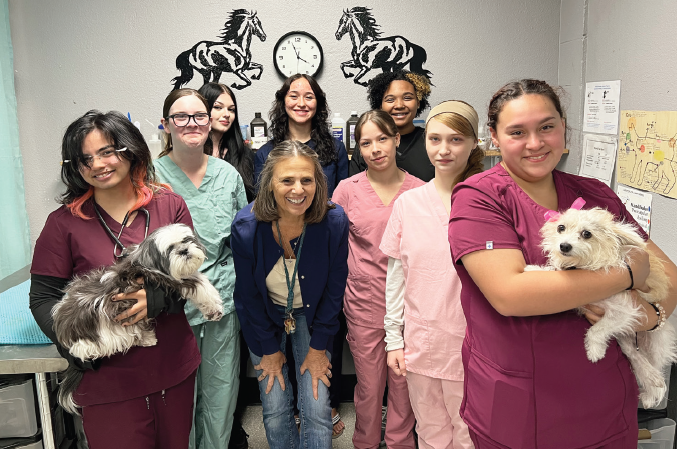
Yuba County Career Preparatory Charter School (YCCPCS), a Marysville-based alternative public high school offering coursework in trades like welding and automotive, is proud to announce its sixth consecutive year producing California Certified Veterinary Assistants (CVAs). This is a milestone that not only reflects our commitment to career technical education, but also to the adherence of industry standards set forth by the CVMA.
Developed ten years ago as a basic exploratory class offering students a glimpse into the vast field of veterinary medicine, YCCPCS’ solo veterinary science class quickly morphed into a comprehensive three-year program after the 2020 adoption of the CVMA CVA course. Divided into three progressively more challenging classes—Foundations, Intermediate, and Capstone—YCCPCS’ program reinforces students’ practical skills and clinical knowledge through carefully sequenced repetition of topics, hands-on labs, veterinary terminology, and real-world clinical experience. After successful completion of all requirements, students are eligible to sit for the CVMA qualifying exam for veterinary assistants.
YCCPCS students begin their CVA journey navigating introductory topics like the positions and duties of the veterinary healthcare team, the veterinary hospital layout, proper sanitation protocols for each area of the hospital, general animal husbandry for in-house patients, breed recognition, preventative care like vaccines, worming, oral hygiene, flea control, microchipping, and pet sterilization, and most importantly, restraint for various procedures. To lend relevance to the curriculum, students begin developing their animal handling skills by working with dogs and cats on loan from school staff.
In year two, veterinary assistant students are introduced to the requirements of the CVMA program, including use of the Patterson Veterinary (online) Academy. While specific work within the academy’s certified course is reserved for year three students, access to other Patterson training classes with similar content, along with relevant textbook lessons, hands-on labs, fieldtrips, and work with live animals, augments the framework laid out by Patterson, thereby assuring our program addresses the entirety of the CVMA’s academic requirements.
By year three, students complete the CVMA-mandated Patterson modules and participate in a clinical internship with a local veterinary hospital or spay/neuter clinic. Although year two coursework has already addressed the same topics (but in much greater depth), year three completion focuses on consolidation of material learned in previous classes, in preparation for the state certification exam. Our goal is to offer students structured preparation geared towards employment or further education posthigh school. In this regard, our Capstone class is articulated with Yuba College, which means the curriculum has been formally approved so that students who complete the program and pass the certification exam receive college credit that applies toward Yuba College’s veterinary technology program.
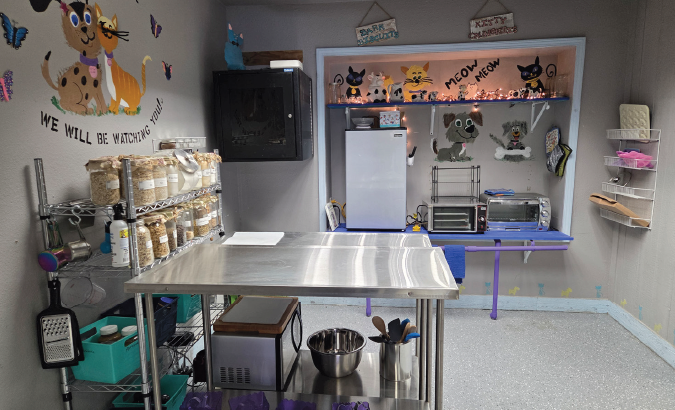
While working on the online modules, students are also given an opportunity to apply skills learned in class to realworld situations within our classroom clinic and later in a clinical rotation with a participating veterinary hospital. Within our classroom clinic, students take patient histories and vital signs, clean ears, trim nails, groom dogs (in our fully equipped grooming salon), microchip, vaccinate, set up fecal exams to identify the most common intestinal parasites and protozoa, discuss the medical and ethical benefits of pet sterilization with clients, and assist the instructor with basic obedience training, all on animals belonging to student families. When students show proficiency in these tasks, they are placed in a local veterinary office, where they continue developing their skills under the guidance of a licensed veterinarian or registered veterinary technician.
Student support for the veterinary assistant program has been strong, reflecting two main groups of learners: those who want practical skills to care for their own pets, and those who aim to pursue formal certification and a career in animal science. At present, the program emphasizes the certification track with rigorous coursework, clinical skills, and competencies aligned to industry standards. However, to better serve pet-care learners, the program is considering a second, shorter track focusing on practical skills like basic animal first aid, nutrition, preventative care, and training.
Community support for our program is increasing, thanks to the significant contributions of the federally funded Workforce Innovation and Opportunity Act of 2014 (WIOA). Implemented in Yuba County, WIOA funding allows our students to receive pay during clinical rotations, subsequently adding pride and authenticity to the learning experience, as well as improving student retention and strengthening partnerships between our program and employers. As local veterinarians see students contributing meaningful work while being paid through WIOA, community investment grows and doors open for future internship placements and potential employment. At present, four of our students are currently placed in internships at different hospitals, all of which employ previous graduates of our program.
More information about CVMA CVA school program can be found here.