This article was originally printed in the Nov/Dec 2025 issue of the California Veterinarian magazine.
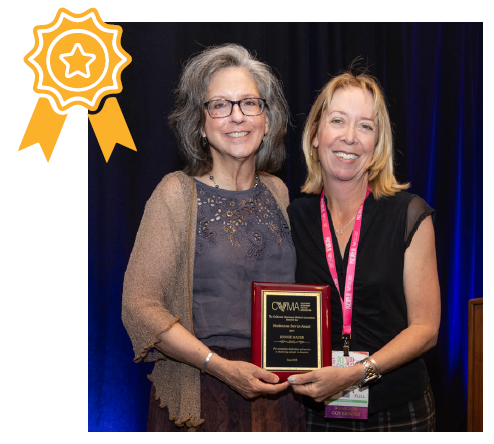
The CVMA annually honors those who have made significant contributions to the veterinary profession through a series of awards. This year, the CVMA recognized Bonnie Mader with the Meritorious Service Award, which honors service on behalf of animals, the veterinary profession, or people who celebrate and promote the human-animal bond in California.
Bonnie was the co-founder and coordinator of the Pet Loss Support Hotline (PLSH) at the UC Davis Weill School of Veterinary Medicine for 20 years. The PLSH offered grieving pet owners a compassionate ear as they faced the painful emotions of considering euthanasia and saying goodbye to their beloved pets. Over the course of its existence, an estimated 15,000 people turned to the hotline, making it a vital resource for the community.
Bonnie credits her work in the veterinary field first and foremost to her brother, Dr. Doug Mader, a world-renowned exotic animal medicine veterinarian. While in veterinary school at UC Davis in the mid-1980s, Dr. Mader sat in on a guest lecture by the late visionary Dr. James Harris, who spoke about the brand-new field of pet loss, the human-animal bond, and veterinary medicine. Dr. Mader urged Bonnie to get involved on the ground floor of pet bereavement studies. Bonnie was intrigued, and when the opportunity arose to work as an assistant researching the human-animal bond with Dr. Lynette Hart—who founded a Sacramento pet loss support group—Bonnie jumped at the chance.
In that role, Bonnie ended up fielding countless phone calls from individuals asking about the program. Most of the people who called were actively grieving, and Bonnie would find herself devoting considerable time counseling the callers. Bonnie’s friend and research peer, Dr. Kelly Palm, suggested a novel idea: Why don’t you train veterinary students to take the calls instead?
“I said to her, with a lot of bravado, ‘Oh no, no, no. They’re veterinary students. You need to have advanced training and counseling and active listening skills,’” Bonnie laughed. “But then I went home and thought, oh for Pete’s sake, veterinary students are very bright. Pet loss has everything to do with veterinary medicine and client communications, and all they need is training.”
With that, Bonnie and Dr. Palm officially established the PLSH, a fully student-run volunteer program. Bonnie crafted and taught the training, and Dr. Palm—then the president of the Human-Animal Bond Club—helped bring in the student volunteers. Word quickly spread about the value of the training, and the program became a hit, with hundreds of veterinary students completing the program over its two-decade existence.
“The hotline never, ever would have achieved what it achieved had it not been for the students,” Bonnie emphasized. “Really, I will carry them in my heart forever.”
Although initially established to assist grieving pet owners, the PLSH also provided a crucial opportunity for future veterinarians to fine-tune essential skills, including active listening, empathetic communication, processing strong emotions from clients, and even writing condolence letters. “[Bonnie] taught me so many skills that have helped me support thousands of clients, thousands of pets, and instilled in me values that have helped me guide interns and hundreds of externs over the years,” wrote Dr. Jason Sweitzer, founding board member of Not One More Vet.
Beyond her work on the PLSH, Bonnie is a trailblazer in the realm of mental health in veterinary medicine. Although mental health is now a commonplace topic within veterinary circles, centering conversations on mental health and suicide prevention during the time of the PLSH was not easy or widely embraced. Bonnie bravely and earnestly dove into this newfound field, advocating for the well-being of both veterinary professionals and pet owners long before such considerations were generally accepted. “Her influence on the mental health of our profession and of the clients and animals that we support is immeasurable,” Dr. Sweitzer wrote.
Although the PLSH closed in 2008, Bonnie continues to lead an online pet loss support group once a month and to champion the importance of mental health in veterinary professionals. “Stress and burnout are very real. You can learn coping skills to deal with stress, but you cannot work through burnout. You’ve got to take a break,” Bonnie said. “I adore people who are in the veterinary profession, and I want them to take care of their mental health. I want them to have long, successful careers.”